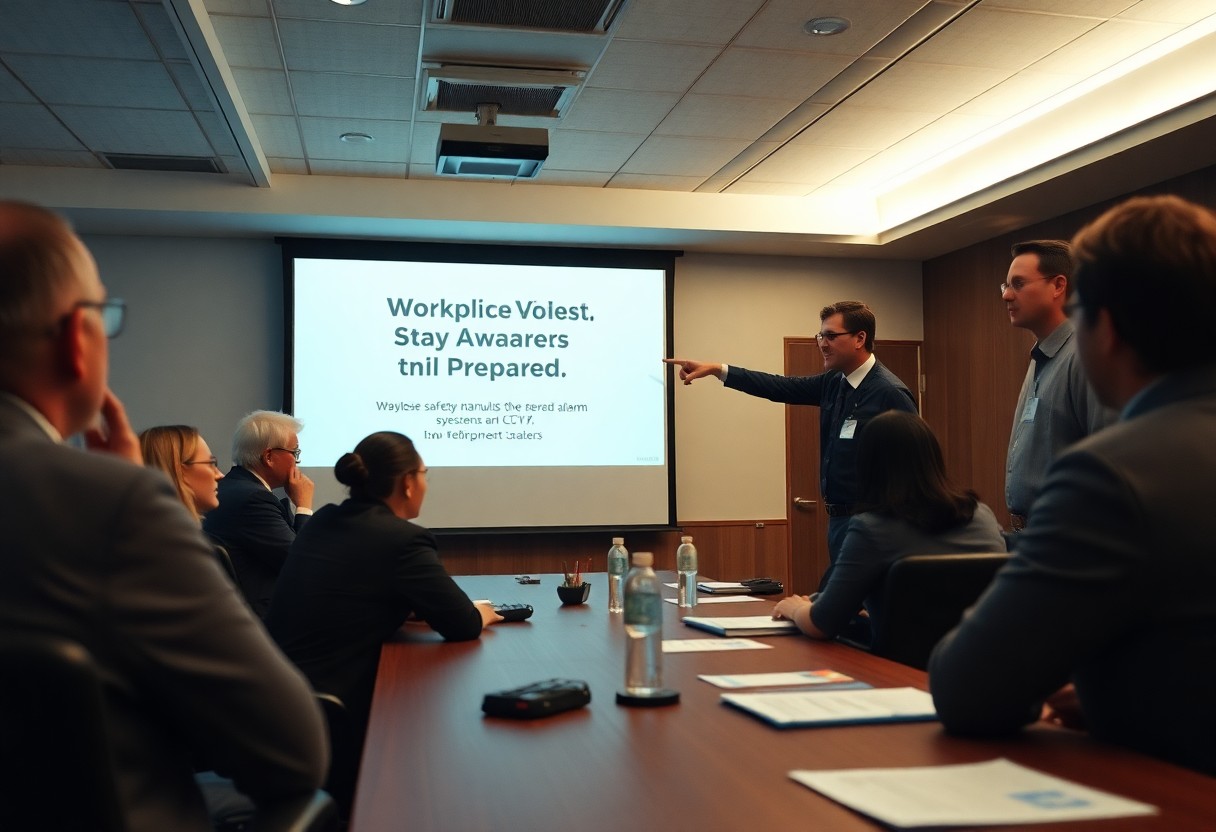
Workplace violence can escalate quickly and presents real risks such as threats, physical assault, and injury; you need clear strategies to protect yourself and colleagues. Learn to spot warning signs, follow reporting procedures, and use de-escalation techniques so preparedness and training reduce harm. Your role includes staying alert to changing behavior, securing your area, and supporting a culture where early reporting leads to safer outcomes.
Key Takeaways:
- Maintain situational awareness – watch for warning signs, keep a safe distance, and know exits and safe zones.
- Follow response procedures – report threats immediately, notify security or authorities, and activate emergency protocols.
- Use de-escalation and training – apply safe verbal techniques when appropriate, attend drills, and use post-incident reporting and support channels.
Understanding Workplace Violence
When assessing risks at work, you must recognize that workplace violence ranges from verbal threats to physical attacks and can affect any role; studies estimate more than 2 million U.S. workers experience workplace violence annually. You should note high-risk sectors like retail, healthcare, and public safety, and prioritize exit routes, reporting, and immediate action plans to reduce harm.
Definition of Workplace Violence
For your workplace, workplace violence means any act or threat of physical violence, harassment, intimidation, or other threatening disruptive behavior occurring on company premises, during work hours, or while you perform job duties. You must treat threats, physical assault, and targeted harassment seriously and report incidents to management or security per policy.
Types of Workplace Violence
Agencies classify incidents into four common categories: Type I (criminal intent), Type II (customer/client), Type III (worker-on-worker), and Type IV (personal relationship). You should use these categories to triage response, tailor prevention, and track trends so your team can apply targeted controls like screening, training, or secure access.
- Type I: Criminals with no legitimate relationship to the workplace (e.g., robberies).
- Type II: Customers, patients, or clients who become violent during service delivery.
- Type III: Current or former employees who threaten or attack colleagues.
- Assume that Type IV incidents involve intimate partners or family members and often require coordination with law enforcement and support services.
| Type I | Criminal intent – examples: robbery, theft, random assault; often in retail environments. |
| Type II | Customer/client – examples: angry patient or guest; common in healthcare and service roles. |
| Type III | Worker-on-worker – examples: disputes escalating to threats or assault; monitor employee relations. |
| Type IV | Personal relationship – examples: domestic violence spilling into the workplace; requires protective measures. |
| Warning Signs | Verbal threats, increased absenteeism, drastic behavior changes, obsession with weapons; log incidents and escalate per policy. |
Delving deeper, you should note that Type II incidents dominate nonfatal reports in healthcare and social services, while Type I often involves property-focused crimes like robbery. You must track incident frequency, times of day, and locations; for example, evening retail shifts often see higher robbery risk, so staffing and lighting adjustments matter.
- Training: De-escalation and scenario drills tailored to each type.
- Environment: Lighting, barriers, and controlled access to reduce criminal opportunities.
- Policies: Clear reporting, after-action reviews, and support for victims to address worker-on-worker issues.
- Assume that coordinated plans with HR, security, and local police improve outcomes when threats are credible.
| Type | Preventive Action |
| Type I | Increase surveillance, cash-handling protocols, and evening staffing; train for robbery response. |
| Type II | Implement service policies, patient behavioral plans, and immediate call-for-help procedures. |
| Type III | Use conflict resolution, progressive discipline, and threat assessment teams. |
| Type IV | Offer protective orders, confidential reporting, and workplace accommodations for affected employees. |
Recognizing Warning Signs
When you observe sudden changes in behavior, attendance, or performance, treat them as potential precursors to violence. Watch for escalating verbal threats, withdrawn or obsessive behavior, repeated rule-breaking, or unexplained mood swings that affect teamwork. This gives you a clear basis to report concerns and protect coworkers.
- Verbal threats
- Withdrawal
- Performance drops
- Obsessive focus
Behavioral Indicators
Pay attention to direct signs such as persistent harassment, stalking, talk about weapons, or sudden displays of intense anger like shouting, pacing, or clenched fists; small actions-like escalating social media attacks-can precede larger incidents. Also note patterns: repeated complaints from multiple coworkers or a rapid decline in work quality are significant. This should prompt you to inform supervisors or security immediately.
- Harassment
- Stalking
- Visible agitation
- Weapon-related talk
Environmental Factors
Physical conditions and policies shape your exposure: isolated workstations, late-night shifts, poor lighting, and blocked exits increase risk, while lack of visible cameras or panic buttons removes deterrents. Survey the area for weak points and note times when staffing drops below safe levels. This signals operational changes are needed to reduce vulnerability.
- Lone-worker shifts
- Poor lighting
- Blocked exits
- No cameras or alarms
Mitigation is practical: schedule two-person coverage for high-risk hours, install visible security cameras and panic alarms, maintain clear egress routes, and enforce visitor controls; for example, many retailers require two-person closing teams to lower assaults. Conduct weekly safety audits and log corrective actions so you can track improvements. This makes hazards visible and actionable.
- Two-person staffing
- Visible cameras
- Panic alarms
- Clear egress
Prevention Strategies
Prioritize a layered approach that combines access control, lighting, CCTV, visitor screening, and clear reporting channels so you reduce opportunities for incidents. Use written policies for escorting visitors, closing off unsecured areas during high-risk shifts, and maintain a centralized incident log. When you coordinate with local law enforcement and security consultants, you create a predictable response path that deters many threats before they escalate.
Developing Safety Protocols
Start by conducting a site-specific risk assessment and map high-risk zones, then define roles for supervisors, reception, and security during an event. Include lockdown, evacuation, shelter-in-place procedures, a communication tree with primary and backup contacts, and an incident-reporting timeline (submit reports within 24 hours). Review protocols annually and after every significant incident to close gaps.
Employee Training and Awareness
Provide initial and recurring training that covers de-escalation techniques, recognizing warning signs, use of duress alerts, and response options like run-hide-fight. Schedule short, focused sessions-onboarding plus quarterly refreshers-and track completion and feedback. You should pair classroom learning with practical drills so staff convert knowledge into effective actions under stress.
Enhance training with realistic exercises: run 1-2 hour scenario-based workshops, tabletop exercises for supervisors, and timed drills that measure response and evacuation times. Incorporate role-play of common situations-verbal threats, aggressive customers, trespassers-and collect metrics (training completion rates, drill response times) to target weak spots. When you analyze results, adjust protocols and coaching to raise overall readiness.
Response Procedures
During an incident you follow established response steps to protect life, secure the scene, and preserve evidence. If threat is immediate, call 911 and trigger any alarms; if safe, move others to a designated safe area or evacuate using planned routes. After safety is ensured, contact facility security and your manager, document what happened with times, locations, and witness names; this supports investigations and any legal action.
Immediate Actions to Take
If you face immediate danger, call 911, activate alarms, and get yourself and others to a designated shelter or evacuate using preplanned routes. Do not engage a threatening person-avoid physical confrontation if a weapon is present. Provide first aid if trained and it’s safe; have someone else alert security and management. When possible note the time, location, suspect description, and any weapons to speed law enforcement response.
Reporting Incidents
Report every incident to your supervisor and security as soon as safety is restored, and file the official incident report within 24 hours. Include time, location, sequence of events, witness names, injuries, and whether law enforcement responded. Preserve physical evidence and video; avoid altering the scene. Timely reports support worker compensation claims, disciplinary actions, and safety improvements.
In your written report include exact timestamps, clear descriptions, photos or video, medical records, witness statements with contact info, and the police report number if applicable. If officers responded, note the officer’s name and badge; if not, record who you called and when. For example, an assault on a cashier at 3:12 p.m. reported with photos and a police case number enabled prosecution and a policy change; follow-up reviews are often completed within 48 hours.

Support Systems
You should rely on layered support: security cameras, badge access, clear reporting channels and trained peer responders all reduce risk. Many organizations pair physical controls with Employee Assistance Programs and scheduled drills so you know evacuation routes and who to call. When an incident occurs, prompt notification to your security team and HR plus documented reports-dates, times, witnesses-speed protective actions and follow-up investigations.
Employee Assistance Programs
You can use your EAP for confidential counseling, safety planning and legal referrals; most programs provide 3-6 confidential sessions per issue and offer 24/7 crisis lines or telehealth options. HR should give you the vendor contact and steps for immediate access, and supervisors can arrange time off or temporary duty changes while you engage services.
Resources for Victims
Call emergency services if you are in danger (dial 911) and reach the National Domestic Violence Hotline at 1-800-799-7233 or text HOME to 741741 for 24/7 support. Local victim advocates, shelters and legal aid can help you secure emergency protective orders, obtain medical care and connect with counseling so you’re not navigating the aftermath alone.
If you pursue formal remedies, document every incident with timestamps, photos and witness names and share them with your advocate or HR; many victim advocates will accompany you to law enforcement or court and can help arrange emergency protective orders often processed within a few days. Also ask about workplace accommodations-temporary schedule changes, remote work or paid leave-and whether the company will implement no-contact directives or security escorts while you remain on site.
Legal Considerations
Beyond response actions, you must be aware that legal exposure can follow workplace violence: OSHA’s General Duty Clause requires employers to address recognized hazards, and civil liability can arise for negligent hiring or supervision. For practical prevention and investigative steps you can follow this guide: Workplace Violence: How to Prevent, Prepare and React …
Workplace Violence Policies
Your written policy should state a zero-tolerance stance, define types of prohibited behavior, and list clear reporting channels and timelines. Include required training frequency (commonly annual), confidentiality protections, and a commitment to investigate within 24-72 hours. You must also outline post-incident support like medical care and Employee Assistance Programs so employees know what to expect.
Legal Obligations and Employer Responsibilities
Under federal and many state laws you are obligated to assess hazards, implement controls, and provide training and supervision proportional to risk. OSHA guidance expects employers to document risk assessments, corrective actions, and training records; failing to do so can result in citations, inspections, and increased liability exposure. You should keep written evidence of your compliance efforts.
More specifically, your legal exposure can include claims for negligent hiring, retention, or supervision, and some sectors (healthcare, education) face statutory reporting or prevention mandates. Coordinate promptly with law enforcement, preserve evidence, maintain victim confidentiality, and offer reasonable accommodations. Statutes of limitations for civil claims often run 1-3 years depending on state law, so timely action and documentation directly reduce your risk.
To wrap up
Now you must apply the awareness and preparedness steps discussed: maintain situational awareness, follow your workplace policies, use de-escalation techniques when safe, report threats promptly, participate in training and drills, and access support after incidents so you and your colleagues remain safer and better prepared to respond.
FAQ
Q: What common warning signs indicate someone might pose a risk for workplace violence?
A: Changes in behavior such as increased agitation, verbal threats, talk of revenge, extreme mood swings, obsessive focus on coworkers or supervisors, substance misuse, and sudden declines in performance can signal elevated risk. Environmental cues include accessible weapons, repeated security breaches, and escalating conflicts in specific areas. Encourage staff to report observations through established channels, document incidents with dates and times, and involve supervisors or security when patterns emerge. Training on behavioral recognition and regular risk assessments of the workplace environment reduce exposure to hazards.
Q: What immediate actions should employees take if a violent incident begins?
A: Prioritize personal safety: evacuate if a safe route exists, use pre-planned escape paths, and assist others only if it does not increase your own risk. If evacuation is impossible, secure a room by locking doors, silencing phones, turning off lights, and staying out of sight. When confrontation cannot be avoided, use de‑escalation tactics-speak calmly, keep distance, and avoid provocative gestures-then withdraw when safe. Call emergency services as soon as it is safe to do so, provide concise information (location, description, injuries), and follow instructions from first responders. Afterward, account for all personnel and report the event through organizational reporting procedures.
Q: How should an organization handle reporting, support, and prevention after an incident?
A: Promptly activate incident reporting and investigation protocols, preserve evidence (video, access logs, witness statements), and complete formal reports for management and authorities. Provide medical care and mental-health support to affected employees, offer time off or modified duties, and arrange confidential counseling. Conduct a debrief to identify system failures, update risk assessments, and revise policies, training, and physical controls (access management, lighting, barriers) as needed. Communicate lessons learned to staff without compromising privacy and schedule refresher training and drills to reinforce procedures and roles.