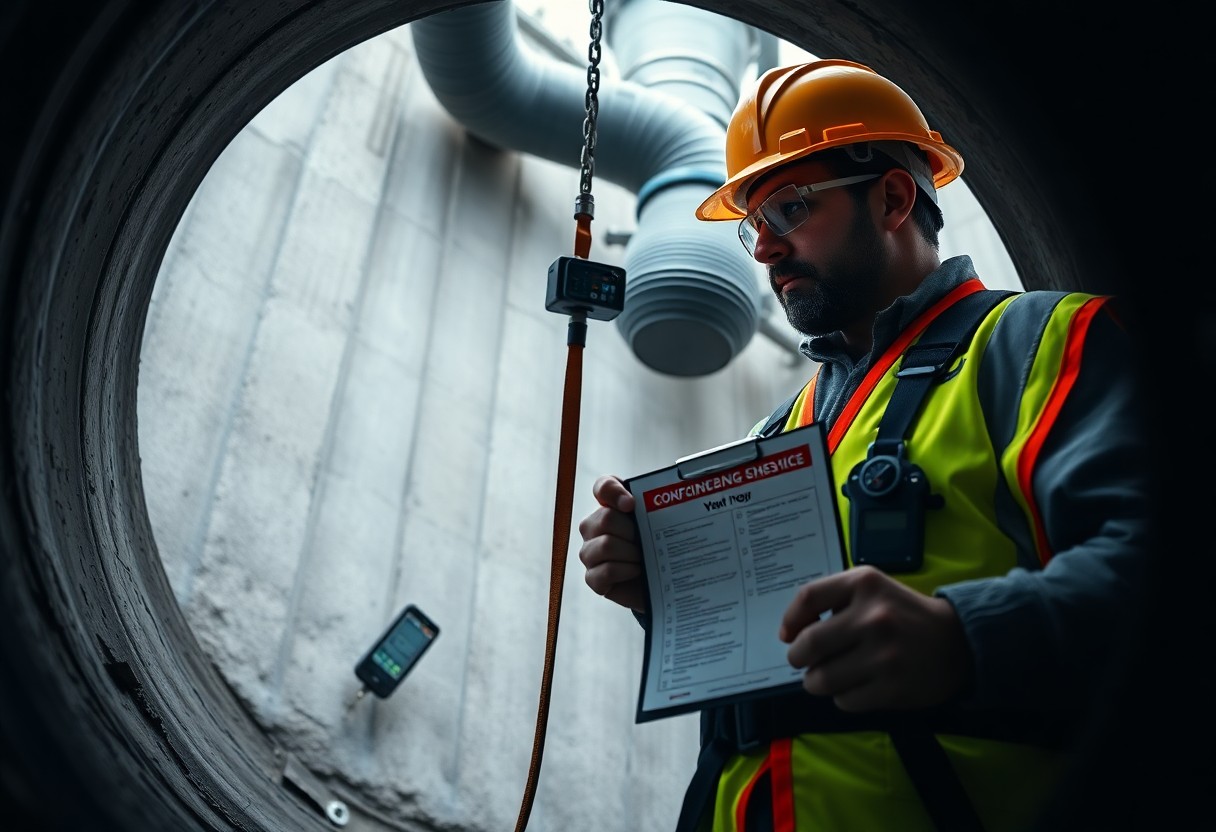
Many confined spaces can expose you to oxygen-deficient or toxic atmospheres, engulfment, and mechanical hazards, so your entry must follow a written permit and entry plan that includes atmospheric testing, ventilation, trained attendants, communication, and a rescue-ready procedure. You are responsible for verifying controls, following lockout/tagout, and ensuring only authorized personnel enter.

Key Takeaways:
- Entry requires a completed permit and documented plan listing hazards, isolation/lockout, atmospheric testing, ventilation, PPE, and authorized entrants.
- Continuous monitoring, trained attendants, and clear communication are required throughout entry; stop work and cancel the permit if conditions change.
- Rescue procedures, trained rescue personnel, and emergency equipment must be in place before any entry begins.
Understanding Confined Spaces
You encounter spaces like tanks, silos, vaults, and manholes that are large enough to enter but have limited entry/egress and aren’t intended for continuous occupancy. OSHA (29 CFR 1910.146) requires permits when hazards exist; typical examples include oxygen-deficient atmospheres, flammable vapor, or mechanical entrapment. Expect work planning to include atmospheric testing, ventilation, and a written rescue plan before you authorize entry.
Definition and Characteristics
You should classify a space as confined if it’s big enough for a worker to enter, has restricted access, and isn’t designed for continuous occupancy. Characteristics include limited openings, internal geometries that trap contaminants, and potential for engulfment (for example, grain bins or hoppers). Under OSHA, a permit-required confined space also contains hazards like IDLH atmospheres, engulfment, or uncontrolled energy sources that demand documented controls.
Hazards Associated with Confined Spaces
You will face atmospheric risks such as oxygen deficiency (<19.5%), oxygen enrichment (>23.5%), flammable mixtures, and toxic gases-H2S has an IDLH of 100 ppm, CO is highly dangerous at elevated levels. Physical dangers include engulfment, mechanical entrapment, electrical shock, and heat stress; NIOSH reports that more than 60% of confined-space fatalities involve victims and would‑be rescuers, so controls and permits must be enforced.
Before your entry, perform and record atmospheric tests on the permit for oxygen, LEL, and any site-specific toxics; use continuous monitoring when conditions can change. Provide forced ventilation until safe readings persist, employ supplied-air respirators for IDLH atmospheres, and rely on a trained rescue team with retrieval equipment rather than untrained personnel. Keep an attendant outside and abort entry if alarms or unsafe readings occur.
Importance of Safety Planning
Before you initiate entry, plan every step: map hazards, assign roles, lock out energy sources, schedule atmospheric testing, and document controls on the permit. Use authoritative resources such as the elaws – OSHA Confined Spaces Advisor for checklist templates. Studies of past incidents show that lack of role clarity and missing permits turns routine entries into multi-worker emergencies; maintain at least one trained attendant, continuous monitoring, and a clear rescue authority to prevent that outcome.
Risk Assessment
Evaluate each space for physical and atmospheric threats: test for oxygen below 19.5% (deficient) or above 23.5% (enriched), flammables near the LEL, and toxins like H2S or CO. You must use calibrated instruments, sample at various depths, and record readings; for example, grain-bin engulfments often begin with rapid oxygen displacement, incapacitating workers in minutes unless stopped.
Safety Procedures
Issue a written permit that lists isolation steps, required PPE, ventilation rates, communication methods, and an on-site rescue plan; verify lockout/tagout per 29 CFR 1910.147 and ensure continuous ventilation until safe readings are sustained. Emphasize the permit and a practiced rescue plan as non-negotiable controls.
Detail procedures: require forced-air ventilation until instruments stabilize within the 19.5-23.5% oxygen range and combustible gases are below the LEL, use intrinsically safe meters, and equip entrants with full-body harnesses and retrieval lines anchored outside. Train attendants in non-entry rescue, run hands-on rescue drills at least annually, and retain permits and drill logs for post-entry review and regulatory compliance.
The Role of Permits in Confined Space Entry
Permits convert your plan into a legally accountable checklist: they record identified hazards, required controls, test results, and authorizations before you enter. Under OSHA 29 CFR 1910.146 a permit is required for permit-required confined spaces and must document isolation, atmospheric testing, ventilation, PPE, rescue arrangements, and the permit duration so you and your team can verify every control is in place.
Permit Requirements
A compliant permit must name the entry supervisor, authorized entrants and attendant, list specific hazards and control measures, and show recent atmospheric readings for oxygen, flammables and toxic gases. Include isolation/lockout steps, required PPE, ventilation methods, and a written rescue plan. Highlight any dangerous limits-for example, oxygen outside the 19.5-23.5% range or flammables above 10% LEL-and ensure the permit is signed and posted at the entry.
Permit Application Process
You initiate the permit by completing a hazard assessment and pre-entry checklist, then perform calibrated atmospheric testing for O2, LEL, H2S, CO and document readings. The entry supervisor verifies lockout/isolation, ventilation rates, and rescue availability before signing the permit; permits are time-limited, must be reissued for shift changes, and cancelled when work is finished.
In practice: identify hazards, specify controls (e.g., forced ventilation at a measured flow like 200 cfm), record instrument calibration dates, list required PPE, and assign roles. Use continuous or periodic monitoring depending on risk, keep the permit with the attendant, and archive it for at least the company retention period to support audits and post-incident reviews.
Best Practices for Confined Space Entry
Adopt a systematic approach: complete the permit, verify lockout/tagout, and assign roles with one attendant per entrant. You should test atmospheres for oxygen, flammables and toxic gases and document O2 between 19.5-23.5%, flammables below 10% LEL, and acceptable contaminant levels before entry. Use mechanical ventilation, appropriate PPE, and a practiced rescue plan so hazards are controlled and the team can respond immediately to changes.
Monitoring and Ventilation
Use calibrated multi-gas monitors and run continuous readings for O2, LEL, H2S and CO, recording values at least every 15 minutes. Purge and ventilate with forced-air blowers until two consecutive readings five minutes apart are stable within safe limits. If oxygen drops below 19.5% or flammables exceed 10% LEL, evacuate and reassess isolation and ventilation before re-entry.
Communication Protocols
Establish a primary and backup communication method-intrinsically safe radios plus a lifeline or whistle-and require continuous contact between entrant and attendant with check-ins every 10-15 minutes. You must brief hand signals and emergency commands before entry, log all exchanges on the permit, and treat any loss of contact as an immediate alarm requiring evacuation and rescue activation.
Test radios and sound signals on site, document a specific emergency signal (for example, three short blasts then one long) and practice it during pre-entry briefings; conduct rescue drills at least every 6 months and coordinate with local emergency responders. Maintain visual line-of-sight when possible, keep rescue retrieval gear (tripod, harness, SRL) staged nearby, and ensure your attendant can activate rescue within minutes if readings or contact indicate an incident.
Training and Qualification of Personnel
You must comply with OSHA 29 CFR 1910.146 by training entrants, attendants and entry supervisors before they participate, and retraining when procedures or equipment change or competence lapses. Many programs require an annual refresher and documented competency checks (written + practical). Focus on practical skills like atmospheric monitoring, lockout/tagout verification and emergency rescue coordination so your team moves from theory to reliable field performance.
Required Training Programs
Provide targeted courses: hazard recognition, confined-space permit procedures, atmospheric testing (use of multi-gas meters), ventilation techniques, respiratory protection (including fit-testing per 29 CFR 1910.134), fall-protection and rescue drills. Blend classroom with hands-on drills-weekly or monthly practical sessions accelerate skill retention-and maintain written records of training dates, instructors and evaluations to show compliance.
Roles and Responsibilities
Define and certify the roles: Entrant follows the permit and PPE, Attendant maintains communication and continuous monitoring, Entry Supervisor authorizes permits, verifies controls and confirms rescue availability, and Rescue Team is trained to the level needed (non-entry or entry rescue, per NFPA 1006). Your documentation must list assigned personnel and their qualifications for each entry.
For example, your attendant must never leave the post and should log gas readings every shift or per your permit; the supervisor signs off only after verifying lockout/tagout and ventilation effectiveness. Train rescue teams on site-specific scenarios (entanglement, engulfment, toxic atmosphere) with timed drills; aim to document response times and corrective actions so you can show measurable improvements after each exercise.
Emergency Response Planning
You must have a written plan that assigns roles, lists contact numbers, and maps entry and egress routes; include coordination with local EMS and reference OSHA 29 CFR 1910.146. Set a performance target such as a 5-minute activation-to-rescue window for immediate hazards, keep updated atmosphere logs at the entry, and specify whether you use an in-house rescue team or a contracted service with documented response times and equipment inventories.
Emergency Procedures
When an alarm sounds, your team must act on a predefined checklist: 1) sound and communicate the emergency; 2) stop all nonimperative operations and secure energy sources; 3) evacuate uninvolved personnel; 4) initiate ventilation and continuous gas monitoring; 5) conduct headcount and log events. Emphasize that untrained personnel must never enter and that the attendant controls reentry until the space is declared safe by competent responders.
Rescue Operations
Your rescue strategy should prioritize non-entry retrieval using retrieval lines, winches, or tripods and keep entry rescue as a last resort with SCBA. Maintain a trained rescue team of at least two rescuers plus an attendant, perform scenario-based training at least annually, and run practical drills quarterly to validate sub-5-minute response capability and equipment readiness.
Operational details matter: equip rescuers with a tripod/tripod winch, full-body harnesses with quick-connect retrieval points, class-rated lifelines, SCBA (minimum 30-minute cylinder), and intrinsically safe gas monitors. You should practice both non-entry retrieval and emergency entry with lockout/tagout and continuous atmospheric monitoring; log each drill, note problems, and retrofit procedures-commonly, improving anchorage placement and pre-rigging retrieval systems cuts average rescue time by >30% in follow-up drills.
To wrap up
With these considerations, you ensure your confined-space entries follow a strict plan and valid permit, including hazard assessment, atmospheric testing and monitoring, ventilation, lockout/tagout, appropriate PPE, trained attendants, clear communication, and an established rescue strategy; you must verify permit completion and documentation, and you have the authority to stop work if conditions change.
FAQ
Q: What are the required elements of a confined space entry plan and permit?
A: A permit must include a clear description of the space and work to be performed, identified hazards, and the specific control measures to eliminate or mitigate each hazard. It should list atmospheric testing results and acceptable entry conditions, required ventilation measures, lockout/tagout and isolation procedures, personal protective equipment, communication methods, authorized entrants, attendants, and entry supervisor names, plus authorization signatures and dates. The permit must also document rescue arrangements and standby personnel, required monitoring frequency, duration and expiration of the permit, pre-entry checklists, special procedural steps (hot work, energized equipment, etc.), and criteria for canceling or reissuing the permit if conditions change. All entries and deviations must be recorded on the permit.
Q: How should atmospheric testing and continuous monitoring be performed during entry?
A: Perform atmospheric testing before entry and after any change in conditions using calibrated instruments that measure oxygen, flammable gases/vapors (LEL), and relevant toxic gases (for example CO, H2S). Record readings and compare them to established acceptable limits. Maintain continuous or periodic monitoring during entry as dictated by the identified hazards; set alarms and define evacuation triggers. Position sensors at representative locations and monitor where workers are breathing; if ventilation is used, verify that it achieves and maintains acceptable conditions. If readings reach or exceed action levels, stop work, evacuate the space, re-evaluate controls, ventilate and retest, and only re-enter after the space meets permit conditions again. Log all test results and instrument calibration checks on the permit or associated forms.
Q: What are the specific responsibilities of authorized entrants, attendants, and the entry supervisor?
A: Authorized entrants must follow the permit and procedures, use required PPE, complete pre-entry checks, maintain communication with the attendant, continuously monitor their own conditions, and exit the space immediately if an alarm sounds or conditions change. Attendants must remain outside the space for the full entry, continuously monitor entrant status and atmosphere readings, keep an accurate count of entrants, maintain communication, initiate emergency procedures if needed, and not enter the space to attempt non-trained rescues. The entry supervisor must verify the permit and pre-entry controls, ensure atmospheric testing and isolation are complete, confirm personnel are trained and equipped, authorize and sign the permit, monitor ongoing compliance, suspend or cancel the permit if conditions change or controls fail, and ensure that rescue services are available and briefed before entry begins.