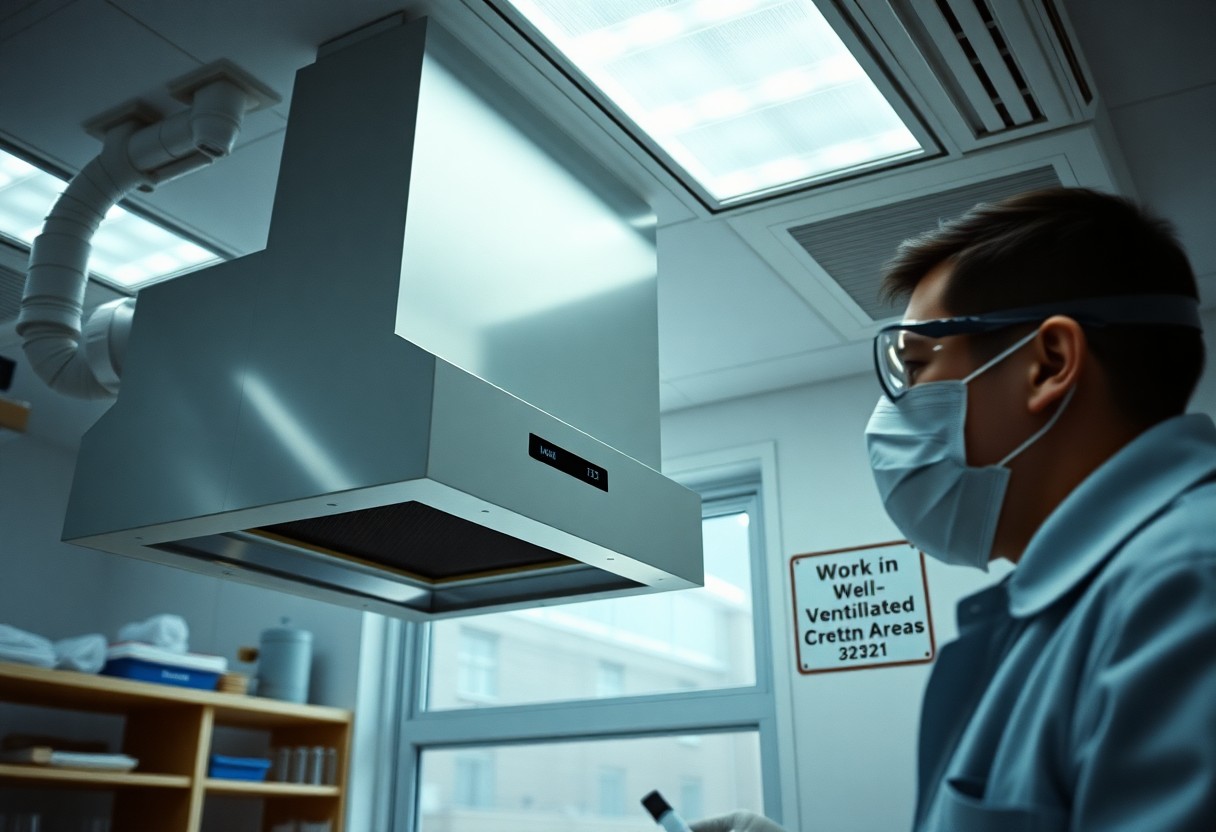
Most chemical fume hazards reach you through inhalation of volatile substances, posing risks like respiratory damage and asphyxiation; you must ensure adequate ventilation-local exhaust, dilution, or outdoors-to reduce concentrations, control exposures, and prevent fire or explosion. Use PPE only as backup, monitor air, follow SDS guidance, and stop work if you cannot maintain safe air quality to protect your health and coworkers.
Key Takeaways:
- Ensure adequate ventilation: use local exhaust, fume hoods, and general dilution ventilation to keep airborne chemical concentrations below exposure limits.
- Apply administrative controls and PPE: reduce exposure time, follow safe work procedures, and use respirators or other protective equipment when ventilation is insufficient.
- Monitor and maintain controls: conduct air monitoring, train personnel on hazards and emergency response, and service ventilation systems regularly.
Importance of Chemical Fume Ventilation
When you control airborne hazards at the source, you lower exposure quickly: properly used local exhaust like a fume hood can cut contaminant levels by over 90% compared with general dilution. You should aim for hood face velocities of 80-120 fpm (0.4-0.6 m/s), keep sash positions correct, and prioritize capture of vapors at the point of release to prevent plume spread into breathing zones.
Health Risks of Inhalation
Short-term inhalation can cause headaches, dizziness, and mucous membrane irritation, while repeated exposures may lead to chronic lung disease, sensitization, or cancer; for example, benzene is linked to leukemia and isocyanates cause occupational asthma. You must treat even low-level, repeated exposures seriously because they often produce delayed, irreversible effects that reduce long-term worker health and productivity.
Regulatory Standards and Compliance
Agencies such as OSHA, NIOSH, and ACGIH set PELs, RELs, and TLVs that you must consult when evaluating controls; OSHA standards (e.g., Hazard Communication 1910.1200) are legally enforceable, while ACGIH TLVs offer lower guidance limits. You are required to keep exposures below applicable limits, document controls, and provide training, PPE, and SDS access for affected workers.
To demonstrate compliance you should maintain exposure monitoring records, perform hood certification at least annually or after changes, and log maintenance and training. You will need routine air sampling frequency based on risk-high-hazard operations often require monthly to quarterly monitoring until controls are proven effective-and keep calibration and inspection proofs available for inspectors and audits.
Adequate Ventilation Design
Types of Ventilation Systems
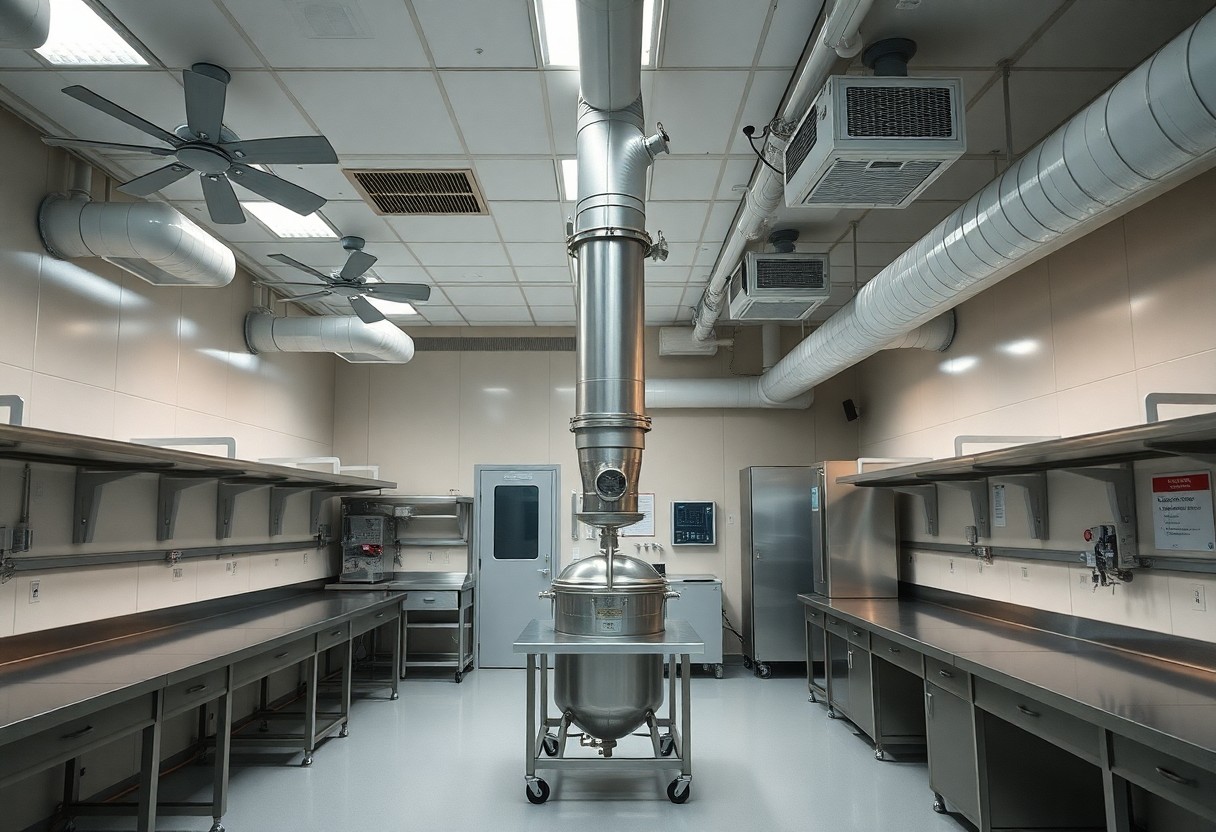
Different workplaces rely on combinations of local exhaust ventilation, dilution ventilation and HVAC zoning to control chemical loads. You size systems to the contaminant: fume hoods often require face velocities of 0.4-0.6 m/s, while general spaces target 6-12 ACH; portable capture units usually deliver 0.5-2 m/s at the source. Assume that you must match system type to process, airborne concentration, and occupancy.
- Local exhaust – you use capture hoods or fume hoods to remove contaminants at the source.
- Dilution ventilation – you increase air changes per hour to reduce background concentrations in non-point-source tasks.
- Downflow booths – you protect operators by directing air away from the breathing zone during spraying operations.
- Chemical scrubbers – you neutralize acid or solvent vapors before atmospheric release when concentrations are high.
- HVAC zoning – you maintain negative pressure (typically 5-15 Pa) for containment rooms to prevent cross-contamination.
| Local Exhaust | Fume hood face velocity 0.4-0.6 m/s; capture velocity 0.5-2 m/s at the source for most solvents. |
| Dilution Ventilation | Target 6-12 ACH for labs; light solvent work often uses 8 ACH as a baseline. |
| Downflow Booth | Downward air 0.3-0.5 m/s to keep particulates and vapors out of the breathing zone. |
| Chemical Scrubber | Use for acid or solvent stacks; design for contact time and reagent dosing to reduce emissions below OSHA/REACH limits. |
| HVAC Zoning | Maintain negative pressure of 5-15 Pa and HEPA or carbon filtration where you handle highly toxic or odorous chemicals. |
Components of Effective Ventilation
You must design systems with reliable airflow, effective filtration (MERV 13-HEPA as needed), responsive controls and scheduled maintenance. Sensors for VOCs and differential pressure should trigger interlocks; typical lab targets are 6-12 ACH and negative pressures of 5-15 Pa. Regular verification of capture velocities (0.5-2 m/s) preserves protection and reduces exposure risks.
Sizing ducts for transport velocities of 7-12 m/s prevents buildup and corrosion, and you should specify backward-inclined fans for efficient, stable flow; select fan duty to maintain designed static pressure under worst-case filters and scrubber loads. Hood geometry and sash position matter – case studies show reducing sash opening from 30 cm to 15 cm can boost face velocity by 30-50% and cut solvent exposures by ~60%. Install differential pressure gauges with alarms, perform quarterly airflow balancing and log readings, and train staff to keep sources within the capture envelope to sustain the system’s performance.
Best Practices for Working in Well-Ventilated Areas
When working with solvents and reactive gases, you should prioritize local exhaust ventilation (hoods, LEV arms) over room dilution; studies show properly positioned LEV can cut airborne concentrations by 70-95%. Conduct a task-based hazard assessment, use PPE as a backup, and set controls so exposures stay below applicable 8‑hour TWA and STEL limits.
Identifying Ventilation Needs
Start by assessing chemical properties-vapor pressure, quantity, and duration-and the work layout; for example, handling high-vapor-pressure solvents in open containers often needs LEV, while small sealed transfers may need only general ventilation. Aim for lab air change rates of 6-12 ACH for routine work and add targeted capture for batch processes or spills.
Regular Maintenance and Monitoring
Schedule routine checks: measure hood face velocity at 80-120 fpm with an anemometer, perform monthly smoke tests on LEV joints, and replace filters per manufacturer guidance. Keep logs of airflow and alarms, and have hoods professionally certified at least annually to ensure adequate capture.
Track trends by logging readings and acting when values shift more than ±20% from setpoints; escalate persistent drops to maintenance to check ducts, fans, or filter breakthrough. Use calibrated manometers and anemometers, train users to run daily visual checks, and perform breakthrough testing for activated-carbon filters when treating solvent vapors to prevent unexpected exposures.
Training and Awareness
You must provide focused training on fume control, including at-hire and annual refresher sessions, hands-on ventilation setup, and use of local exhaust. Use resources like Scout’s Toolbox Talks on ventilation for short modules. Document attendance, show practical demos, and include task-specific controls and expected exposure limits so workers can apply measures immediately.
Employee Education on Fume Hazards
You need training on specific chemical hazards, health effects, and exposure limits; teach signs like headaches, dizziness, throat irritation and long-term risks such as organ damage or cancer from chronic exposures. Cite standards: OSHA PELs and ACGIH TLVs (measured in ppm or mg/m3) to link symptoms to numbers. Use case examples-e.g., benzene exposure linked to leukemia-to make the risk concrete and actionable.
Emergency Procedures and Response
Prepare clear steps for spills, overexposures, and ventilation failures: immediate evacuation routes, designated muster points, shut-off procedures for HVAC and local exhaust, and how to don emergency respirators. Post contact numbers and assign a trained responder team. If air monitoring shows concentrations at or above IDLH levels, you must initiate evacuation and medical evaluation without delay.
Run full drills at least every six months, log outcomes, and coordinate with local fire or HAZMAT teams for site-specific plans. Ensure eyewash and shower stations meet ANSI Z358.1 with 15 minutes flushing, keep portable gas detectors calibrated annually, and store spill kits rated for the chemicals on site so your response is fast and effective.
Case Studies and Real-World Applications
Key outcomes
In multiple sites you see measurable improvements: installing local exhaust ventilation achieved an average 85% reduction in airborne solvent levels, raising air changes per hour from 2 to 10 and lowering VOCs from ~80 ppm to 10 ppm. Training and signage cut reported exposure incidents by >90%. Continuous monitors kept concentrations under OSHA PELs in 24/7 operations. These outcomes show practical gains when you prioritize proper chemical fume ventilation and controls.
Documented cases
- 1) Automotive spray shop (2019): You installed a new spray booth with LEV; VOC concentrations fell from 120 ppm to 12 ppm (90% drop), ACH rose from 1.5 to 12, and reported respiratory complaints dropped from 4/year to 0-1/year.
- 2) University teaching lab (2021): You upgraded 20 hoods to VAV fume hoods and enforced sash policies; measured solvent exposures declined from ~15 ppm to 0.5 ppm, energy use decreased 28%, and near-miss reports fell by 95%.
- 3) Metal plating facility (2018): After adding targeted capture and improved room ventilation, airborne hexavalent chromium fell from 40 µg/m³ to 2 µg/m³, keeping workers well below the OSHA PEL 5 µg/m³.
- 4) Electronics fabrication (2020): You implemented continuous gas monitoring; solvent spike incidents fell from weekly highs of 25 ppm to controlled peaks under 2 ppm, maintaining levels beneath the ACGIH TLV for routine operations.
- 5) Small furniture shop (2022): Portable LEV plus respiratory protection reduced respirable dust and adhesive VOCs from hazardous peaks (~200 mg/m³ dust / 250 ppm VOCs) to safe working levels (5 mg/m³ dust / 20 ppm VOCs), eliminating acute symptom reports.
Innovations in Ventilation Technology
Emerging Systems
Using compact local exhaust with variable-speed drives, you can achieve targeted capture velocities of 0.4-0.6 m/s at fume hoods and 0.5-2.0 m/s at source arms to limit plume escape. Combining HEPA filtration (99.97% at 0.3 µm) with activated carbon removes particulates and VOCs. Modern energy-recovery ventilators deliver 70-90% heat recovery, cutting HVAC loads, while sensor networks and AI controls let you detect spikes and trigger containment automatically.
Conclusion
With these considerations, you will prioritize proper fume ventilation by assessing airflows, using local exhaust and PPE, following safe work practices, and stopping work if odors or symptoms occur; maintaining ventilation systems, training, and written procedures helps you prevent exposures and maintain a safe workplace for yourself and colleagues.
FAQ
Q: How can I tell if the work area is well-ventilated enough for chemical fume-producing tasks?
A: Signs of inadequate ventilation include persistent chemical odors, visible haze or vapor clouds, workers experiencing headaches, dizziness, eye/nose/throat irritation, or reports of unusual odors after work begins. Use objective checks: consult the chemical Safety Data Sheet (SDS) for exposure limits and recommended controls; perform air monitoring for airborne concentrations of relevant contaminants or use direct-reading instruments for VOCs, particulates, or specific gases; verify that local exhaust systems (fume hoods, snorkels, downdraft tables) are operating at the designed capture velocity and that general HVAC is providing sufficient make-up air and air changes for the activity. If odors or symptoms are present, treat ventilation as inadequate until testing shows exposures are below occupational limits or engineering controls are improved.
Q: What ventilation methods and work practices reduce exposure to chemical fumes?
A: Apply the hierarchy of controls with emphasis on engineering: use local exhaust ventilation (LEV) positioned as close to the emission source as practical, choose appropriate devices (fume hoods, canopy hoods, slot/slotless capture hoods, downdraft benches), and ensure proper makeup air to maintain stable airflow patterns. Keep the source below the hood sash and avoid cross-drafts from doors, fans, or HVAC diffusers. Maintain and test ventilation systems regularly (face velocity checks, smoke tests, filter changes, belt/fan servicing). Combine engineering with administrative controls: limit task duration, schedule high-fume operations during low occupancy, post signage, train workers on safe procedures and SDS information, and use work barriers to separate sources from others. Use respiratory protection only as a supplement when engineering controls cannot reduce exposures below limits, and implement a respirator program (fit testing, medical evaluation, training) per regulations.
Q: What immediate steps should be taken if ventilation fails or a worker is exposed to hazardous fumes?
A: Evacuate the affected area and move exposed persons to fresh air immediately. If symptoms are severe (loss of consciousness, breathing difficulty, chest pain), call emergency services and provide first aid (maintain airway, administer oxygen if trained). Isolate and secure the affected area to prevent others entering, shut down the source if it can be done safely, and notify supervisors and safety/industrial hygiene personnel. Conduct air monitoring before re-entry and implement temporary controls (portable exhaust, increased general ventilation) as needed. Document the incident, seek medical evaluation for exposed workers, investigate root causes, and correct ventilation, maintenance, training or procedural deficiencies to prevent recurrence.