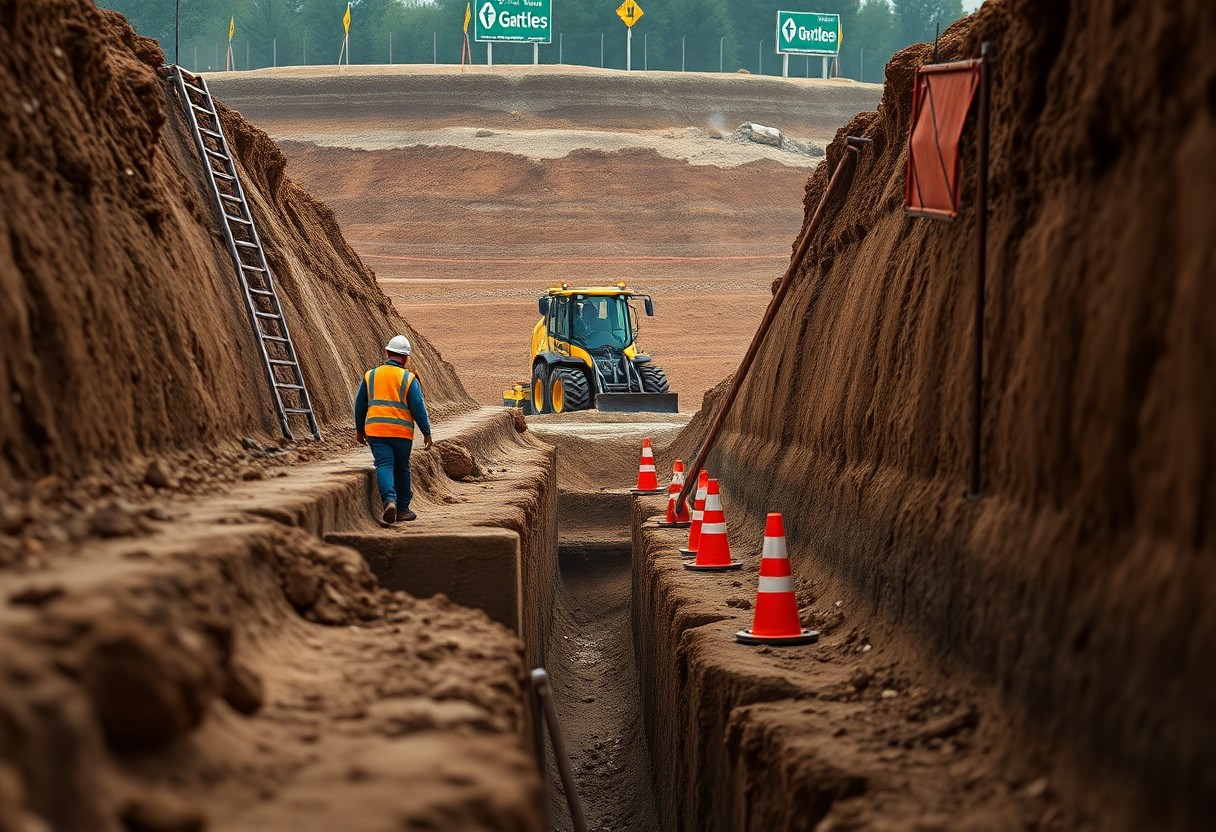
Safety depends on you: inspect sloping, shoring, and access to prevent trench collapse, use PPE, and enforce soil testing and permit compliance to protect workers and reduce fatalities.
Key Takeaways:
- Always inspect trenches daily and after weather events; use protective systems such as sloping, benching, shoring, or trench boxes to prevent cave-ins.
- Soil type, groundwater, and nearby loads increase collapse risk; have a competent person assess conditions and test for hazardous atmospheres before entry.
- Provide safe access/egress within 25 feet, keep spoil piles and equipment at least 2 feet from trench edges, and maintain emergency rescue plans and proper PPE.
Protective System Requirements
You must implement protective systems that address soil type, depth, and traffic, using sloping, benching, shoring, or shielding to prevent cave-ins. Consult the Toolbox Talk: Basic Excavation Safety for practical checks and worker briefings.
Standards for Sloping and Benching
Sloping and benching protect you by reducing collapse risk; follow OSHA angles by soil type, limit bench heights, and have a competent person verify stability before entry.
Implementation of Shoring and Shielding Systems
Shoring and shielding require you to select equipment rated for depth and soil, install per manufacturer specifications, and inspect daily to prevent collapse or worker entrapment.
Inspect shoring and shielding before each entry: confirm proper placement and secure connections, verify manufacturer’s load ratings and alignment, maintain unobstructed emergency egress, and control water or vibration that can trigger rapid failure. Your competent person must document inspections, adjust systems for changing conditions, and remove crews at the first sign of soil movement or imminent cave-in.

Safe Access and Egress Protocols
You must establish designated entry and exit points, position ladders or ramps within 25 feet of workers, and keep routes unobstructed so you preserve clear egress and reduce the chance of entrapment or cave-in injuries.
Ladder Placement and Stairway Requirements
Place ladders on firm footing at a 4:1 angle, secure both ends, and provide stable stairways where needed so you maintain three points of contact while entering and exiting trenches.
Maintaining Clear Travel Paths and Exit Points
Keep travel paths free of spoil, tools, and equipment so you protect accessible escape routes and avoid tripping or blockages that can lead to rapidly escalating hazards.
Ensure you inspect and mark egress routes before each shift, keep spoil piles and machinery at least 2 feet from trench edges, provide adequate lighting, and assign responders to remove obstructions immediately to prevent a blocked exit or a secondary event that causes a cave-in or injury.
Atmospheric Monitoring and Ventilation
Atmospheric checks ensure you detect toxic gases and oxygen deficiency before entry; combine continuous monitoring with planned ventilation to keep trenches safe and prevent asphyxiation or explosions.
Testing for Hazardous Gases and Oxygen Deficiency
You must use calibrated meters to check methane, hydrogen sulfide, carbon monoxide, and O2 levels before and during work; alarm thresholds should trigger immediate evacuation.
Implementing Effective Air Quality Controls
Use forced-air ventilation and exhaust systems so you maintain positive airflow and dilute contaminants; portable fans and ducting help remove accumulating hazardous gases.
Ventilation plans require you to size fans, select ducting, and position intakes to avoid dead zones; combine portable and fixed systems with continuous sampling so you detect rising gas levels early and adjust airflow or halt entry to protect entrants.
Emergency Preparedness and Response
Prepare for emergencies by designating an on-site response leader, posting evacuation routes, and maintaining communication systems so you can react immediately to a trench incident; keep escape ladders, atmospheric monitors, and first aid kits ready and accessible.
Rescue Equipment and Personnel Training
Train crew members on proper use of shoring, sloping, and retrieval gear, run regular drills, and certify rescuers so you can perform safe extractions while minimizing risk of secondary collapse.
Immediate Action Plans for Trench Failures
Act immediately if a trench fails: evacuate intact areas, call for trained rescue teams, and secure the perimeter while you assess hazards like toxic atmospheres, engulfment, and unstable soils.
When a collapse occurs, you should not enter the trench; instead, call emergency services, have trained rescuers use retrieval systems and shoring, monitor air quality, establish a safe perimeter, document conditions, and prepare for immediate medical triage to treat asphyxia and crush injuries while minimizing further soil movement.
Conclusion
Drawing together, you apply strict hazard assessments, shoring or sloping, atmospheric testing, and trained supervision so trenching and excavation work meets safety standards and prevents collapses, injuries, and regulatory penalties.
FAQ
Q: What are the primary hazards in trenching and excavation, and how can they be controlled?
A: Cave-ins, falling loads, hazardous atmospheres, water accumulation, equipment strikes, and underground utilities present the greatest risks. Cave-ins are controlled by using proper protective systems such as sloping, benching, shoring, or shielding selected based on soil type and depth. Falling loads are reduced by keeping spoil and equipment away from trench edges, using tag lines and exclusion zones, and ensuring operators and spotters are trained. Atmospheric hazards are managed by testing for oxygen deficiency, combustible gases, and toxic vapors when there is any potential for hazardous atmospheres, and by ventilating or using respiratory protection when required. Water is controlled with dewatering, pumps, or protective systems designed for saturated conditions. Utility strikes are prevented by verifying as-built drawings, contacting utility locating services before digging, and exposing utilities by hand digging or vacuum excavation near marked lines. Access and egress must be provided within 25 feet of workers in trenches, and a competent person must inspect excavations daily and after any event that could increase risk.
Q: What protective systems must be used and how is the correct system chosen?
A: Protective systems include sloping, benching, shoring, and trench boxes (shielding). Selection depends on soil classification, trench depth, site conditions, and presence of water or vibration from nearby traffic or equipment. Soil must be classified by a competent person into categories such as stable rock, Type A, Type B, or Type C, with Type C requiring the most conservative measures. OSHA requires protective systems for excavations 5 feet deep or greater unless a competent person determines there is no potential for cave-in; shorter excavations still need protection when hazards exist. Sloping angles and benching dimensions follow tables based on soil type; shoring systems must be engineered or installed per manufacturer guidance; trench boxes must be appropriately sized and set on firm, level ground so they fully protect the work area. Spoil piles, materials, and equipment must be kept at least 2 feet from trench edges. A written plan and, when applicable, engineered drawings should be used for complex or deep excavations and for systems supporting adjacent structures.
Q: What key topics and items should be covered in a trenching and excavation safety talk or toolbox meeting?
A: The safety talk should cover hazard recognition, required protective systems for the day’s work, roles and responsibilities of the competent person, and emergency and rescue procedures. Include site-specific items such as soil type, water conditions, utility locations and markings, planned access/egress points, location of spoil and equipment, and traffic or equipment exclusion zones. Review PPE requirements (hard hats, high-visibility apparel, foot protection, gloves, and respiratory protection if needed), atmospheric testing protocols, and lockout/tagout for buried lines. Emphasize daily inspection requirements and the need to stop work and contact the competent person if conditions change. End the session with a short checklist: confirm protective system in place, verify inspections were conducted today, confirm egress location, confirm utility clearances, and document attendance and any action items.