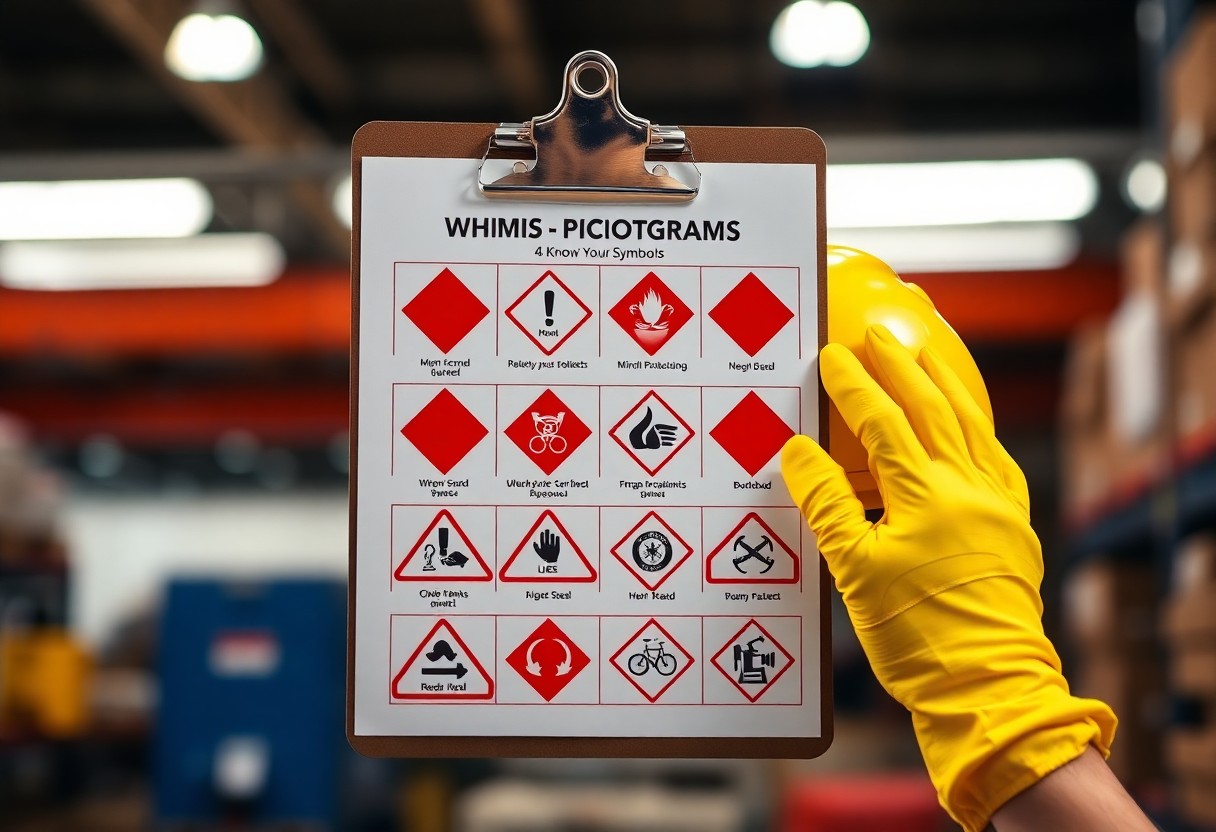
There’s a clear set of WHMIS pictograms that help you quickly identify hazards so you can act safely; when you see symbols for flammable, toxic, or corrosive materials you must follow the label and SDS instructions, wear appropriate PPE, and update your procedures. Knowing these icons lets you protect your health, avoid exposure, and prevent incidents in your workplace.
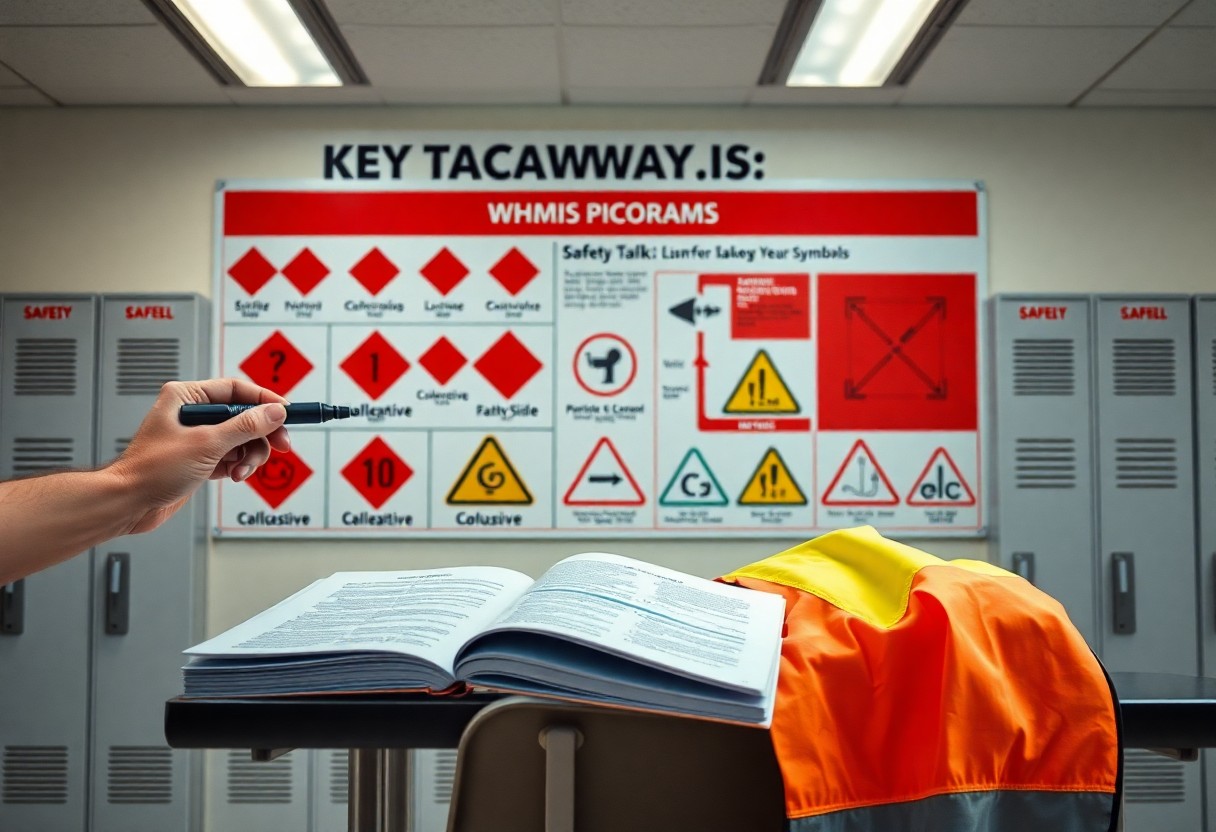
Key Takeaways:
- Pictograms identify the hazard class (e.g., flammable, corrosive, toxic) using a black symbol on a white background with a red diamond border-match the symbol to the hazard before handling.
- Use pictograms to determine controls: appropriate PPE, engineering controls, safe storage, and spill/response procedures as directed by the label and SDS.
- Workers need training to recognize symbols and follow label/SDS instructions to reduce exposure and prevent incidents.
Understanding WHMIS
When you interpret WHMIS you connect labels, Safety Data Sheets and training to everyday tasks; the system, updated to align with GHS in 2015, standardizes hazard communication across Canada. Employers must provide current SDSs and clear labels so you can identify hazards-like corrosives or flammables-before handling. Practical skills such as reading pictograms, selecting proper PPE and following spill procedures reduce incidents and speed emergency response.
What is WHMIS?
WHMIS is the national framework that lets you know what hazardous chemicals are present and how to handle them. It combines supplier labels, workplace labels, and SDSs formatted into 16 sections, plus mandatory worker education. Since the 2015 GHS-alignment, pictograms and standardized hazard statements give you consistent cues-from the skull and crossbones indicating acute toxicity to the flame showing flammability-so you can act safely and quickly.
Importance of WHMIS in Workplace Safety
WHMIS helps you prevent injuries and legal penalties by making hazards visible and actionable; for instance, clear labels and SDSs let you avoid mixing oxidizers with solvents, a common cause of fires. Employers who enforce training and PPE selection cut exposure risks-and if you follow the SDS recommendations for chemicals like hydrochloric acid or ammonia, you greatly reduce burn and inhalation incidents while ensuring regulatory compliance.
Your employer must ensure you receive education before first use and whenever hazards change; this includes hands-on training, label interpretation and access to up-to-date SDSs at the point of use. In practical terms, that means having emergency eyewash, spill kits, and written procedures for high-risk tasks-for example, confined-space solvent transfers-so you can respond within seconds if a label or pictogram signals oxidizer, corrosive, or toxic danger.
Overview of WHMIS Pictograms
Seeing a red diamond on a label gives you immediate context: WHMIS uses nine standardized pictograms to signal hazards like flammable solvents, corrosive acids, or toxic substances. You rely on these symbols to triage risks-identifying which materials need ignition control, spill containment, or restricted access-and to act fast during incidents where seconds matter.
Definition of Pictograms
Pictograms are concise graphic symbols, black on white inside a red diamond, that identify a hazard class and hint at severity; for example, the skull and crossbones denotes acute toxicity, while the corrosion image indicates skin- or metal-damaging substances. You see them on supplier labels and SDS section 2 to link the visual cue with formal hazard statements.
Role of Pictograms in Hazard Communication
Pictograms act as a visual shorthand so you can prioritize controls and PPE before reading details: a flame warns to eliminate ignition sources, a gas cylinder tells you to check pressure and ventilation, and a exploding bomb flags handling restrictions for reactive materials. First responders and floor staff use these symbols to decide immediate actions within minutes of encountering a product.
They do not replace full information: you must consult the label’s signal word and hazard statements plus the SDS. Use SDS section 8 for exposure limits and recommended PPE, and follow precautionary statements for storage and spill response-pictograms start the conversation, but procedures and monitoring close it.
Categories of WHMIS Pictograms
WHMIS pictograms group into three main categories – physical, health, and environmental hazards – and the system uses nine core symbols under WHMIS 2015 (GHS-aligned). You should use these groups to quickly map a label to controls: physical symbols guide engineering and isolation, health symbols drive medical surveillance and PPE, and environmental symbols affect spill response and disposal choices.
Physical Hazard Symbols
Physical hazard pictograms flag risks like flammability, explosion, pressure and oxidizing potential; examples include acetone and gasoline for flammables, 30% hydrogen peroxide as an oxidizer, and compressed oxygen cylinders. You must control ignition sources, use proper storage segregation, grounding/bonding for liquids, and implement pressure-relief procedures where cylinders or reactive chemicals are present.
Health Hazard Symbols
The health hazard pictogram (silhouette with starburst) covers long-term and severe effects such as carcinogenicity, respiratory sensitization, reproductive toxicity and target organ toxicity; common offenders include benzene, asbestos and certain solvents. You should consult SDS hazard classifications, apply exposure monitoring, and prioritize engineering controls before PPE to limit chronic workplace disease risks.
Digging deeper, health hazard classifications use routes, dose-response data and toxicity endpoints-acute toxicity categories, mutagenicity, and carcinogenicity-reported in SDS sections 2 and 11; for example, crystalline silica exposures have produced silicosis outbreaks when controls failed, so you must implement local exhaust ventilation, medical surveillance and exposure records when handling such classified materials.
Environmental Hazard Symbols
The environment pictogram warns of aquatic toxicity and bioaccumulation; although it’s part of GHS, it is not mandatory under Canadian WHMIS for workplace labels, so you may see it on supplier labels or SDS to signal risks to fish and ecosystems from spills of pesticides, copper compounds or some solvents. Your spill plans and disposal methods must reflect that hazard.
For practical control, environmental classifications distinguish acute and chronic aquatic categories using LC50/EC50 data (e.g., acute Category 1 often uses LC50 ≤ 1 mg/L). You should use secondary containment, prevent run-off, follow SDS disposal sections, and notify environmental authorities for reportable releases to limit long-term ecosystem damage.
Detailed Analysis of Each Pictogram
Break down each of the nine WHMIS pictograms by hazard class, common workplace sources and immediate controls: for example, the flame appears on paint thinners and solvents, the skull and crossbones flags acute toxins like cyanide salts, and the corrosion covers strong acids and bases used in cleaning. You should pair each symbol with a specific control-ventilation, containment, or PPE-and note signal words and SDS sections for action.
Symbols and Their Meanings
Flame means flammable or self-reactive; flame-over-circle signals an oxidizer; skull-and-crossbones denotes acute toxicity; exclamation mark indicates irritation or less severe hazards; corrosion warns of skin/eye damage; gas cylinder covers compressed gases; exploding bomb flags explosives/unstable chemicals; health hazard points to carcinogenicity or respiratory sensitization; environmental pictogram signals aquatic toxicity. You should read SDS sections 2 and 8 to map each pictogram to controls.
Real-World Applications of Pictograms
On the shop floor you use pictograms to set storage, handling and emergency plans: label 20-200 L drums of solvents with the flame symbol, segregate oxidizers from fuels, and post corrosion warnings at dip tanks. Emergency responders rely on these symbols to pick extinguishing media and PPE quickly; because you see the icon immediately, you can isolate the hazard and limit exposure.
When you implement pictogram-based procedures, train staff to act on the icon: for instance, if the gas cylinder symbol appears, you assign cylinder-securement, leak checks and gas-detection monitoring; if the exploding bomb appears, you restrict impact and heat sources and use remote handling where feasible. Employers must provide WHMIS training so your team knows how each pictogram translates into specific safe work permits, storage rules and spill-response steps.
Implementing WHMIS Training
To implement WHMIS training effectively, schedule initial instruction for all new hires and refreshers at least annually, combining a 30-60 minute e-learning module with a 1-2 hour hands-on session. Use the Safety Talk – WHMIS Pictograms – Know Your Symbols as a quick pictogram reference. Track attendance and assessments, aiming for 80%+ competency and clear documentation for inspections.
Importance of Training Employees
You must train employees on label interpretation, SDS access and safe handling so they can select the correct PPE and controls; provide training at hire, when new chemicals arrive and after incidents. Practical drills and toolbox talks cut response times and help you reduce exposure risks, while documented training protects your workplace from regulatory enforcement and costlier operational downtime.
Best Practices for WHMIS Training
Mix brief online modules (15-45 minutes) with site-specific hands-on sessions, scenario-based drills and practical demos; use short quizzes with an ≥80% pass threshold and monthly toolbox refreshers. Involve supervisors in assessments, translate key materials where needed, and keep records accessible for audits to ensure training becomes part of daily routine rather than a checkbox.
Schedule quarterly drills for high-risk tasks and annual SDS reviews; measure effectiveness with post-training quizzes, supervisor observations and tracking near-misses and incident rates. Set measurable goals (e.g., 0 reportable exposures, 90% training completion) and use an LMS to automate reminders, certificates and retraining triggers when you introduce new products or after any incident.
To wrap up
Conclusively, you must be able to identify WHMIS pictograms and interpret their hazard information so your workplace handling, storage, and emergency responses reduce risk; use labels, safety data sheets, and training to guide decisions, report concerns, and follow procedures for proper PPE, containment and disposal to keep yourself and colleagues safe.
FAQ
Q: What do the WHMIS pictograms represent and how should I interpret them during work?
A: WHMIS pictograms are standardized symbols on supplier and workplace labels that indicate specific hazard types. Common pictograms and meanings: Flame – flammable liquids, solids, aerosols or combustible dusts; Flame over circle – oxidizers that can intensify fires; Exploding bomb – explosives, self‑reactive substances, organic peroxides; Gas cylinder – gases under pressure; Corrosion – skin corrosion, serious eye damage, and corrosive to metals; Skull and crossbones – acute toxicity with potentially fatal effects after short exposure; Exclamation mark – irritant, skin sensitizer, less severe acute toxicity, or narcotic effects; Health hazard (silhouette with starburst) – carcinogenicity, respiratory sensitization, reproductive toxicity, or target organ toxicity; Environment (dead fish/tree) – hazardous to aquatic life; Biohazardous infectious material – infectious agents. When you encounter a pictogram, check the signal word (Danger/Warning), read hazard and precautionary statements on the label, consult the SDS for detailed handling, PPE, first aid and storage instructions, and follow workplace procedures for safe use and storage.
Q: How should I respond to a spill, exposure, or other incident involving a WHMIS‑labeled product?
A: Secure the area and protect yourself using PPE specified on the label/SDS; eliminate ignition sources if the product is flammable or an oxidizer. Consult the SDS immediately for hazard‑specific spill control and first aid. For minor spills use the recommended absorbents and waste disposal methods; for large releases evacuate the area, notify your supervisor and emergency responders, and prevent runoff to drains where environmental hazards exist. Follow first aid guidance from the SDS: inhalation – move the person to fresh air and seek medical attention if symptoms persist; skin contact – remove contaminated clothing and rinse skin for at least 15 minutes; eye contact – flush eyes for at least 15 minutes and obtain urgent medical care; ingestion – do not induce vomiting unless instructed by medical personnel. Document the incident per workplace policy and implement corrective actions to reduce future risk.
Q: What practical steps should workers take to use WHMIS pictograms effectively and stay safe?
A: Always read the product label and SDS before handling a chemical; verify the label includes pictograms, a signal word and precautionary statements. Use engineering controls (local exhaust, ventilation), administrative controls (safe work procedures, permits) and the PPE specified for the substance. Segregate incompatible chemicals (e.g., oxidizers from flammables, acids from bases), store compressed gases upright and secure, and limit on‑site quantities to what is needed. Know which SDS sections to consult quickly (especially sections 2 for hazards, 4 for first aid, 7 for handling, 8 for exposure controls and PPE, and 13 for disposal). Participate in WHMIS training and toolbox talks, report missing or damaged labels and SDSs, and report spills or near‑misses so controls and procedures can be improved.